
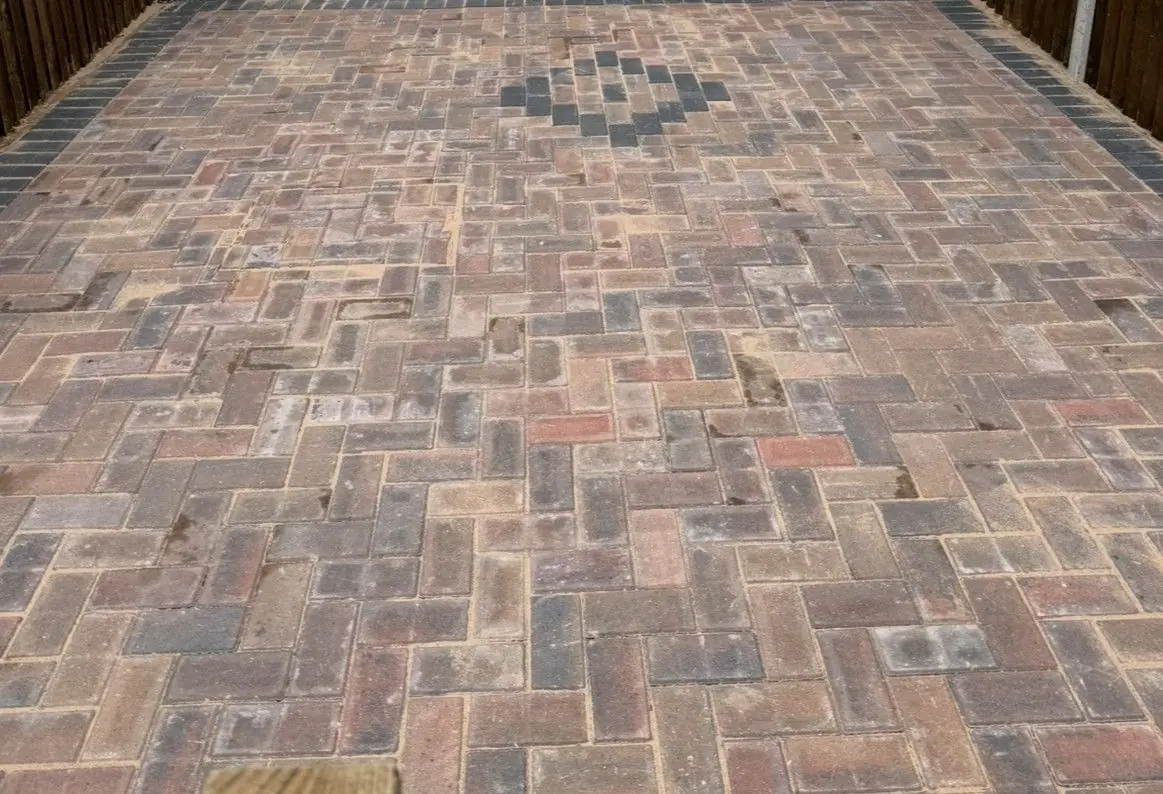
A driveway takes the weight of a car every day and the rain off the front of the house, so the surface matters more here than anywhere else in the garden. Block paving in herringbone with a charcoal border is a finish Steve lays often, and old drives can be taken up and relaid. If you are thinking about gravel or concrete instead, ask Steve about it when he comes to quote. Here is how the three most common choices compare.
Block paving: hard-wearing and easy to repair
Block paving is made of small concrete or clay blocks laid on a bed of sand over a compacted sub-base, with kiln-dried sand brushed into the joints. Laid in a herringbone pattern, the blocks lock together in every direction, which is why it is the usual choice where a car turns on the drive. A contrasting border holds the edge and frames the drive.
Its biggest advantage is repair. If a block cracks, gets an oil stain or has to come up to reach a drain, it can be lifted and relaid without anyone noticing the join. The trade-off is upkeep: the joints need topping up with sand now and then, and weeds or moss can take hold in them if they are left.
Standard blocks shed water rather than letting it through, so a block-paved front drive needs somewhere for the rain to go. Permeable block paving, with wider joints and a free-draining base, is the answer where that is a problem.
Gravel: quick, permeable and noisy underfoot
Gravel lets rain soak straight through, it is usually the quickest surface to lay, and the crunch of a car or footsteps on it is a small security bonus. It needs a firm, compacted base and a solid edge to stop it spreading onto the lawn or the pavement.
The downsides are the ones you notice day to day. Gravel ruts where tyres turn, it can be hard going with buggies, wheelchairs and wheelie bins, and stones get carried into the house and out into the road. A strip of block paving at the entrance and a gravel stabilising grid underneath both help a lot.
Concrete: one solid surface
A concrete drive is poured in one piece, either plain or pattern-imprinted to look like stone or setts. It is smooth to walk on and has no joints for weeds. Its weakness is that it cannot flex: if the ground moves or the base was thin, it cracks, and a crack in concrete is very hard to repair without the patch showing. Like standard block paving, it sheds water, so the drainage has to be planned.
Rainwater and the five square metre rule
In England, laying a new or replacement hard surface of more than five square metres in a front garden needs planning permission, unless the surface is permeable or the rainwater runs off to a lawn, a border or a soakaway within your own property. Gravel and permeable paving usually meet that rule by themselves. A standard block or concrete drive meets it with drainage that keeps the water on your side of the boundary.
A new dropped kerb is a separate approval from the highway authority. In Dartford and Gravesend that is Kent County Council; in Orpington it is Bromley Council. It is worth sorting before the drive is laid, so the new surface and the kerb line up.
What matters more than the surface
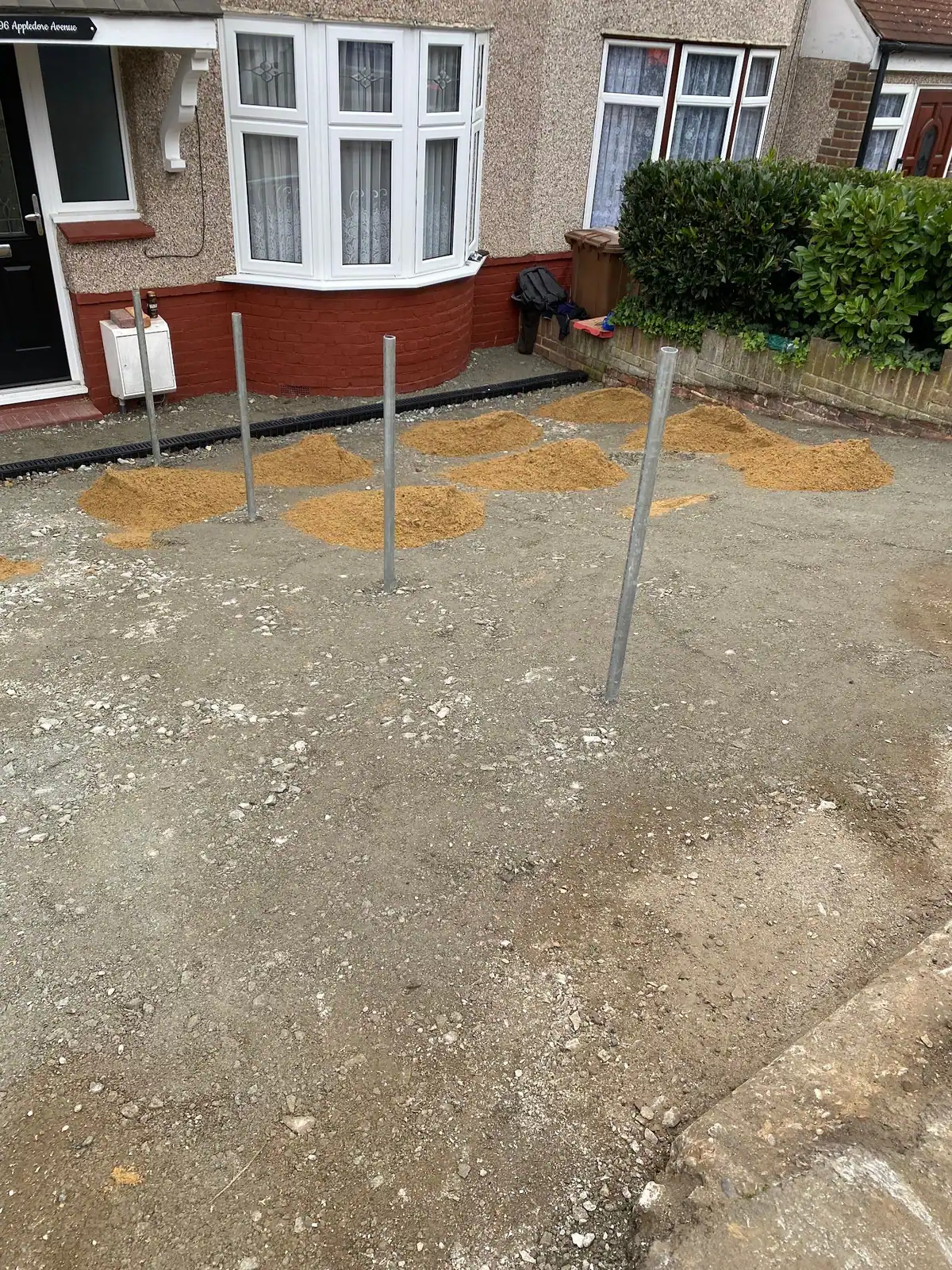
Every driveway surface fails the same way when it fails: the ground underneath moves. The old surface and soft soil have to come out, a sub-base of crushed stone goes in and is compacted in layers, and the finished surface needs a slight fall so water runs away from the house and the garage rather than towards them. Edging holds the whole thing together at the sides.
So the honest answer to "which is best" is the one that suits how you use the drive, laid on a base that is done properly. If you are weighing up a new drive, see driveways and block paving for Steve's own work, and the photos in the gallery.
Common questions
Which driveway surface lasts longest?
Any of them can last for many years if the sub-base under it is right, and any of them fails early if it is not. Block paving has the edge on repairs, because a damaged or stained block can be lifted and replaced on its own.
Do I need planning permission for a new front driveway?
Not if it is five square metres or less, or if the surface is permeable, or if the rainwater runs to a lawn, border or soakaway within your property. A larger impermeable drive with no drainage like that needs planning permission. A new dropped kerb needs separate approval from the highway authority.
Can an old drive be resurfaced rather than dug out?
Sometimes. If the old base is sound and only the surface is tired, it may be repairable. If the drive has sunk, rutted or cracked across, the base is usually the cause and needs digging out. Steve takes up and relays old drives as well as laying new ones, and he can tell you which you need when he comes to quote.
Get a free quote
Planning a new drive in Dartford or nearby? Send Steve a photo of the front of the house on WhatsApp, or call 07463 232 434, for a free quote.
Get in touchor call 07463 232 434